HORIZON Europe "ENACT" (GAP-101157151)
"Environmental Effect on Health Care and Wellbeing and Active Interventions"
Funding program: HORIZON.2.1.2 - Environmental and Social Health Determinants
Focus area: Building a low-carbon, climate resilient future (LC)
Topic: HORIZON-HLTH-2024-ENVHLTH-02-two-stage
Funding instrument: HORIZON-RIA - HORIZON Research and Innovation Actions
Coordinator: Alliance for IOT and Edge Computing Innovation (AIOTI)
Time frame: 1 January 2025 - 30 June 2028
Non-communicable diseases (NCDs) account for 80% of the disease burden as well as for the majority of premature deaths in the EU; diminishing the citizens’ quality of life, life expectancy and increasing the financial burden (from those affected to the health system). During the last 3 decade environmental stressors have been addressed through numerous studies, which have raised concerns about the detrimental effects of the environment on human health. Most evaluated environmental stressors are air temperature, particulate and gaseous air pollutants, urban noise, food pollutants and radiation.
By end of 2022, air pollution was reported to be responsible of an excess mortality of 311.000 people per year in the UE-27 , driving not only premature deaths but also an increased risk of vascular diseases such as ischemic heart disease, stroke, and other non-communicable non-vascular diseases like chronic respiratory diseases or depression. Some newly considered stressors such as electromagnetic field, and light exposure are also susceptible to affect human health (e.g. ocular and dermatological NCD diseases).
ENACT aims at building a pathway to generate clinical, technological and economic short & long-term impact targeting local and regional stakeholders and create impact by: Developing a state-of-the-art environmental risk score and analyzer driven framework and platform to predict, monitor and prevent the exposomic risk of acute and chronic health conditions of chronic vascular and non-vascular NCDs.
This new exposomic risk score and analyzer will support:
- patients
- health professionals/hospitals
- policy makers
ENACT aims at reducing the human and financial burden of NCD, considering potential individual vulnerability factors, and reinforcing both a clinical and a policy implementation that enables prevention and disease management for higher quality of life..
WEB Portals:
- ENACT on Europa: https://cordis.europa.eu/project/id/101157151
- WEB portal: https://enact-he.eu/
- Zenodo: https://cordis.europa.eu/project/id/101157151
- LinkedIn: https://www.linkedin.com/company/enact-project-he
- YouTube: https://www.youtube.com/watch?v=cu6DFf3oahA&ab_channel=EnactProject
Example Developments:
Example data from in-situ environmental sensor: https://rfsat.com/projects/HORIZON-ENACT/ThingSpeakViewer.html
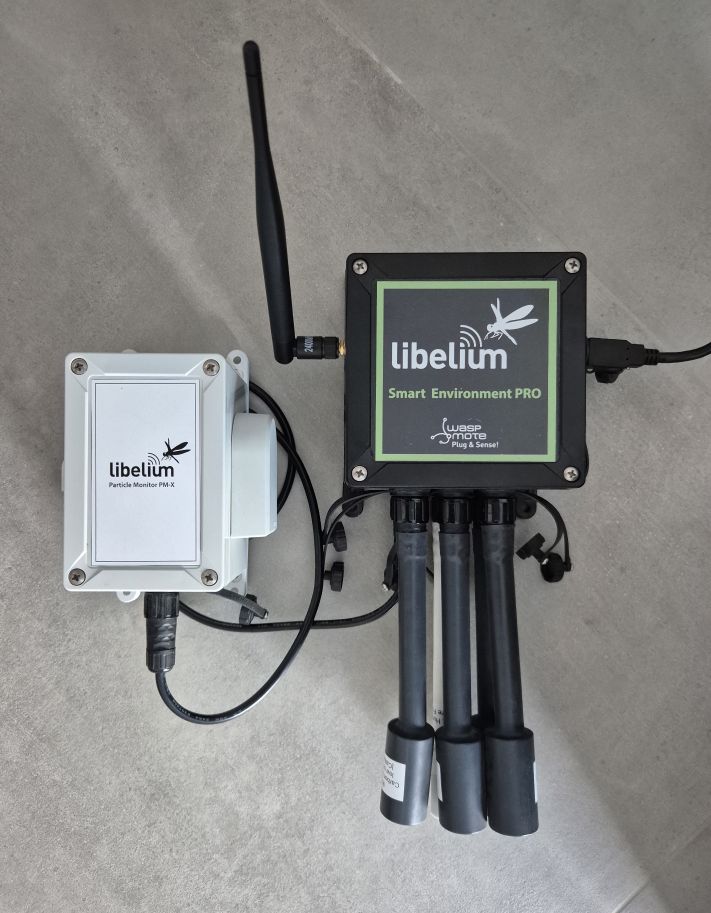
This left (embedded) sensors currently supports:
- Nitrogen oxide (NO)
- 9376-HA-P - Nitrogen dioxide (NO2)
- 9377-HA-P - Sulphur dioxide (SO2)
- 9371-LC-P - Carbon monixide (CO)
- Hydrogen Sulphide (4H2S)
- 9374-P - Ozone (O3) parameters
- 9370-P - Ambient atmospheric Temperature, Humidity and Pressure
The Plug & Sense node supports:
- Port A : 9371-LC-P - Carbon Monoxide (CO) - calibrated, low concentration
- Port B : 9377-HA-P - Sulfur Dioxide (SO2) - calibrated, high accuracy
- Port C : 9374-P - Ozone (O3) - calibrated
- Port D : PM-X - Libelium Particle Monitor (OPC-N2)
- Port E : 9370-P - Ambient atmospheric Temperature, Humidity and Pressure
- Port F : 9376-HA-P - Nitrogen Dioxide (NO2) - calibrated, high accuracy
Applications developed to collect and monitor data being collected from above sensors are presented later on.
The indoor environmental sensor, built upon Raspberry PI-Zero and with ENVIRO+ gas sensor board:


This sensor node currently supports the following pollutants:
- Particulate matter: PM1/PM2.5/PM10
- Climate data: ambient temperature, humidity and barometric pressure
- Air quality: TVOC, eCO2
- Gas pollutants: CO, NO2, C2H5OH (ethanol), H2 (hydrogen), NH3 (ammonia), CH4 (methane), C3H8 (propane), C4H10 (iso-butane)
- Visible light intensity
- Noise level (MEMS microphone).
Latest news:
ENACT Project HE turns the hashtagexposomic approach into operational tools for health and policy. ENACT consortium met in Brussels in mid-February 2026 to agree next steps of the framework implementation into concrete, interoperable outputs. At the core of ENACT is the exposomic approach integrating environmental, lifestyle, and biological exposures across the life course, and linking them to non-communicable disease (hashtagNCD) outcomes. For more infomation refer to the ENACT post on LinkedIn
Latest developments:
As part of Task 4.3 on "Graph-based optimized localization of sensors and gateways", RFSAT has developed a Java-Script based WEB application for optimising the placement of environmental sensors, with consideration for ground elevation and urban footprints, both directly contributing to the way that gas pollutions propagate within the natural environment, affecting both the reliability and accuracy of measurements. Furtherfmore, presence of major city road arteries is also considered (where available) to place sensors closer to main sources fo pollutants. Future work will provide additrionbal consideration for inrastrctures and industries generally known for significantly contributing to environmental pollutions. While ENACT pilots and replcation cities have been pre-coded within the application, relevant data can be re-inserted using external data files.
The application can be accessed from: https://rfsat.com/projects/HORIZON-ENACT/sensor_placement.html

As part of Task 4.1 on "Development of environmental monitoring system", RFSAT has developed a Java-Script based WEB application for modelling the dispersal of air pollutions based on teh information obtained from available air quality measuring stations, 3rd-party national, private and Open Access data repositories, as well as custom data uploaded by users. Based on known ground elevation, urban building footprint and current weather conditions, the dispersal of pollutants is being modelled. Certainly, the more measurements are available per region, the more accurate the modelling results are.
The application can be accessed from: https://www.rfsat.com/projects/HORIZON-ENACT/air_dispersion.html

As a proof of concept, we have also enabled online access to our Libelium Plug & Sense Environment Pro sensor node.
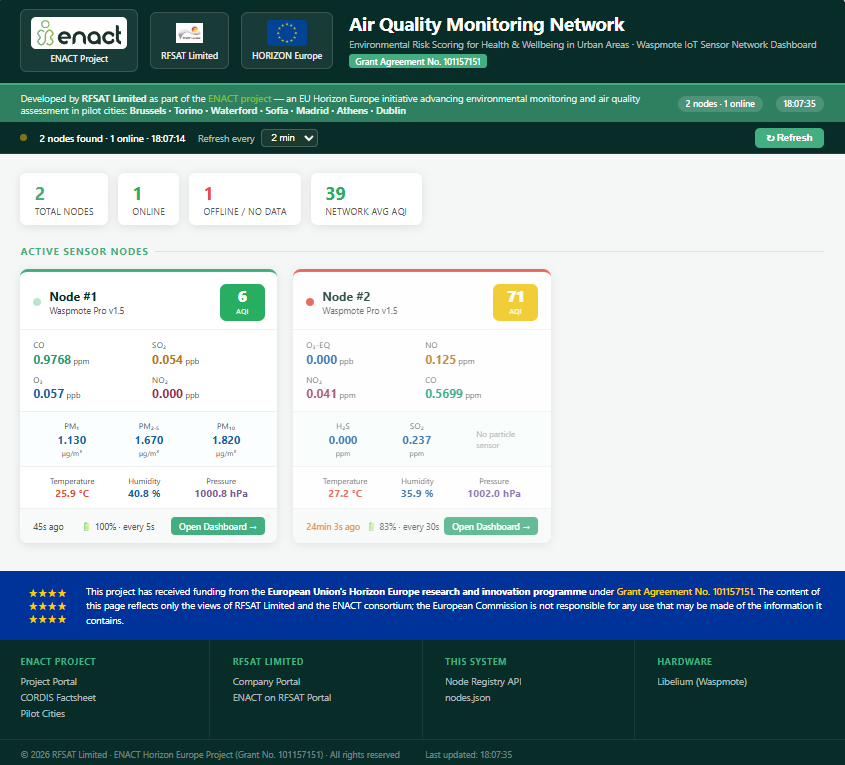
Furthermore an Android mobile applications has also been produced, which can be downloaded from: ENACT Monitor for Android (.apk)

As part of its work in Task 4.2 on "Wearables for physiological signal acquisition", RFSAT has developed WEB and native Android applications for collecting data from Shimmer3 devices.
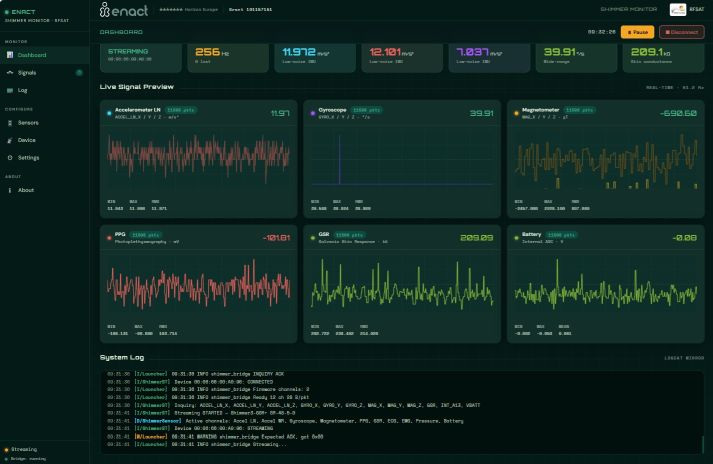
The WEB-based application required a bridge to operate on the local PC, which can be downloaded from the main page, after going to "Connect".
The most appropriate way is to download the whole package (ZIP-file) and ruin the "start_enact_monitor.bat" script, which runs all pre-requisites and then the main application.
Screenshots from the native Android application while collecting data from GSR+ Shimmer3-based sensor is shown below.
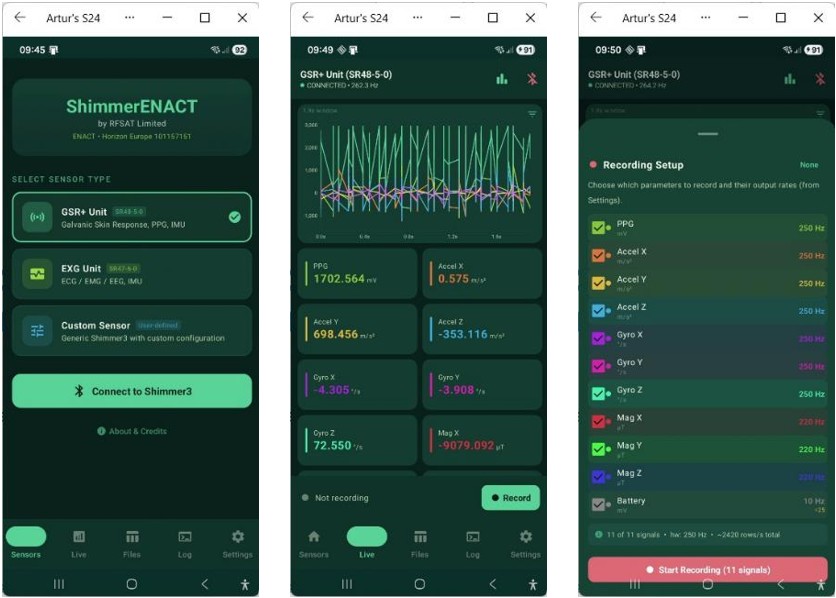
The latest version of the "ShimmerENACT" application can be downloaded from 
RFSAT Publications reporting on its results in ENACT project:
- Krukowski Artur and Emmanouela Vogiatzaki, "Building Environmental Intelligence Layer: Air Pollution Modelling & Sensor Data Integration", to be presented at the special session "ENACT Mid-Term Symposium" of the AIOTI Days 2026 event, Florence (Italy), 28-29th September 2026
- "IoT and Edge Computing EU Funded Projects Landscape", Open Access report by Alliance for AI, IoT and Edge Continuum Innovation (AIOTI), July 2, 2026

-
"The Role of remote monitoring sensors in health and well-being", Open Access report by Alliance for AI, IoT and Edge Continuum Innovation (AIOTI), 2nd July 2026

WEB Portals:
- ENACT on Europa: https://cordis.europa.eu/project/id/101157151
- Project WEB portal: https://enact-he.eu/
- ENACT on ZENODO: https://zenodo.org/communities/enact-he/